Horse Property Barndominium: A Middle Tennessee Buyer’s Guide (2026)
A horse property barndominium works well in Middle Tennessee when you plan the land first and the house second. Figure about 2 to 3 acres of good pasture per mature horse, keep the stalls in a separate building or behind a real fire separation, and budget fence and barn as seriously as the home. Tennessee gives farm buildings some relief from county zoning, but the septic office, the lender and the insurer will still treat your house as a house.
This guide walks through the acreage math, barn layouts, the 2026 budget and the rules that catch new horse owners, using real numbers from Williamson, Davidson, Rutherford, Maury and Marshall counties. If you are still deciding whether to build at all, start with our Middle Tennessee barndominium guide and come back.
How Many Acres Do You Need Per Horse in Tennessee?
University of Tennessee Extension says about 2 to 3 acres per mature horse (1,000 to 1,200 pounds) when pasture provides most of the diet, and 2 to 4 acres to go without supplemental hay, depending on the grass, the soil and how you rotate. Those are pasture acres. The house, driveway, septic field, barn and any wooded slope come off the top.
So a four horse plan looks like this: 10 pasture acres at 2.5 per horse, plus about 2 acres for everything else. That is 12 acres of usable ground, and a 12 acre tract with a steep hollow or a wet bottom may not deliver it. Here is what that much land runs at Land.com median asking prices from September 2026, the same figures used in our best places to build near Nashville guide.
| County | Median asking price per acre | 12 acres at that price | Horse notes |
|---|---|---|---|
| Marshall | $19,700 | About $236,000 | Lewisburg is home base for Tennessee Walking Horse breeders |
| Maury | $35,971 | About $432,000 | Pasture and rolling farms, shallow rock in spots |
| Davidson | $63,727 | About $765,000 | Warner Parks bridle trails, limited large tracts |
| Rutherford | $82,758 | About $993,000 | Tennessee Miller Coliseum and MTSU horse science |
| Williamson | $95,290 | About $1.14 million | Leiper’s Fork horse country, Natchez Trace riding nearby |
Treat those as starting points. Small tracts often ask more per acre than the median, and existing fence, a barn or road frontage changes the math. Browse current land for barndominiums, or look through Maury County homes for sale and Marshall County homes for sale if an existing place with a barn might suit you better.
What to Check on the Land Before You Offer
- Grass. Much Tennessee pasture is KY-31 tall fescue, which carries a fungal endophyte. UT calls it good forage for horses except pregnant mares, so anyone breeding needs a pasture plan and a vet in the conversation.
- Winter mud. Middle Tennessee clay turns gates, waterers and run-in sheds into soup. Budget a gravel heavy use pad at each one.
- Water. Creeks are lovely, but check the floodplain and plan frost-proof hydrants. See our guide to barndominium septic and well before you assume a well will carry house and stock.
- Septic field location. Horses and heavy equipment do not belong on a drain field. Fence it out from day one.
- Deed restrictions. Plenty of rural subdivisions limit livestock or outbuildings. Read the covenants before you read the listing twice.
Barndominium With Horse Stalls: Attached, Detached or Run-In?
The picture everyone has is one big roof with the kitchen on one end and stalls on the other. It can be done, and Tennessee has examples, including listings with living quarters attached to the barn. Honestly, for most families it is the wrong first choice.
| Setup | Best for | Upside | Tradeoff |
|---|---|---|---|
| Stalls under the same roof | Short budget, small lot, owner who wants to hear the barn | One shell, one slab, steps from bed to stall | Fire, ammonia, flies, dust, hardest insurance and resale conversation |
| Detached stable | Most horse owners | Keeps smell and hay risk away from the house | Second building, more driveway and utilities |
| Run-in shed with pasture | One to three easy keepers | Cheapest, healthy turnout, little stall work | Harder with a sick or injured horse, no indoor tack or feed space |
Why a Horse Barn Attached to the House Gets Complicated
Hay and shavings burn fast, and damp hay can heat on its own. The home building code spells out the separation between a house and an attached garage, as covered in our floor plans with shop guide, but a stable is a different animal. Code officials and engineers may reach for other standards, and NFPA 150, the fire code for animal housing, added a horse facilities chapter in its 2019 edition. Ask the county building department how it will treat a mixed building before you pay for plans.
Then there is daily life. A horse produces roughly 50 pounds of manure a day by common estimates, and ammonia, flies and dust travel. Moist barn air against a metal wall is also the exact problem in our barndominium insulation guide. If you do connect them, a breezeway between two buildings gets you the look and the short walk with far less risk.
Stable Dimensions That Actually Work
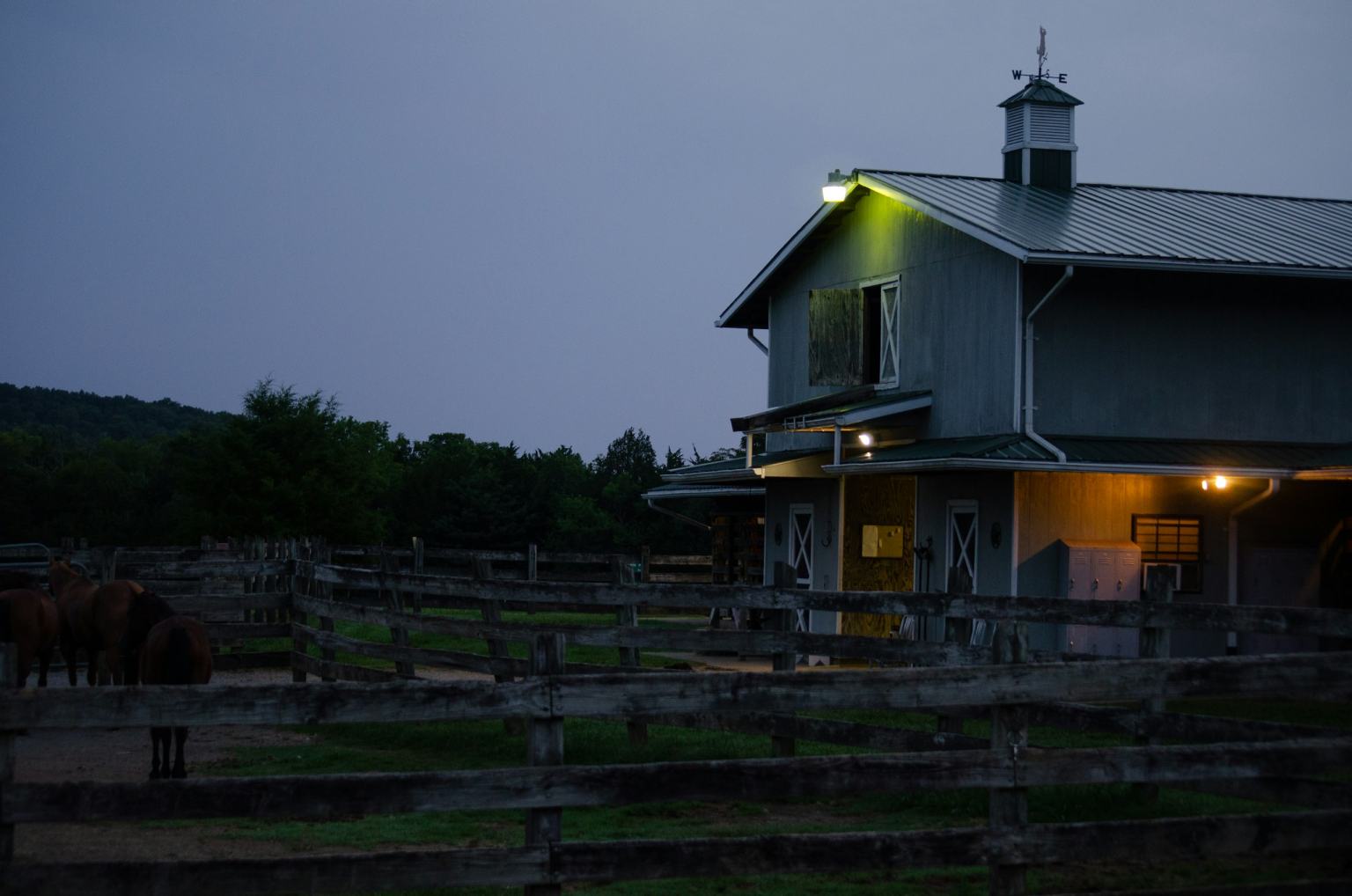
- Stalls: 12 by 12 feet for an average horse, 14 by 14 for larger ones, 16 by 16 for a big draft.
- Aisle: 12 feet is a common recommendation, enough to turn a horse and pass a wheelbarrow or small tractor.
- Ceiling: 10 to 12 feet is common, and lower ceilings cut air movement.
- Hay: store the bulk of it in a separate building, not in a loft over the bedrooms.
- Frame: post frame is common for stables, and our post frame vs red iron guide explains the moisture concerns at the ground line.
What Does a Horse Property Barndominium Cost?
Here is a worked example for 12 acres in Maury County with a 2,000 square foot home and a detached four stall barn. Barn, arena and fence figures come from 2026 online cost guides that vary widely, so use them to plan a conversation with local bidders, not to set a final budget.
| Line item | Low | High |
|---|---|---|
| 12 acres at the Maury median | $432,000 | $432,000 |
| 2,000 sq ft turnkey home at $130 to $180 per sq ft | $260,000 | $360,000 |
| Four stall barn | $90,000 | $240,000 |
| About 2,640 feet of perimeter fence at $15 to $45 per foot | $40,000 | $119,000 |
| Site prep, drive, septic, well, power | $25,000 | $100,000 |
| Total before an arena | About $847,000 | About $1.25 million |
The fence line assumes a simple 10 acre square, which is 660 feet per side, and it does not count cross fencing or gates. For the house line, see the full breakdown of the cost to build a barndominium in Tennessee, and our barndominium site prep cost guide covers the site number. The same plan in Marshall County would save nearly $200,000 in land alone.
Riding Arena Costs
Cost guides put a 60 by 120 foot outdoor arena around $25,000 to $60,000, and a 100 by 200 around $90,000 to $240,000. A standard 20 by 60 meter dressage ring is about 66 by 197 feet, or roughly 12,900 square feet. Expect 3 to 6 inches of footing over a 4 to 8 inch compacted base, and in our rainfall, the drainage under it matters more than the sand on top.
Build It or Keep Boarding?
Full board commonly runs about $600 to $1,200 a month nationally, so two horses cost roughly $14,400 to $28,800 a year. Local barns can land well above or below that. Boarding alone rarely justifies the build. People do this because they want horses out the back door, and that also means feeding at 6 a.m. in January, every day, or paying someone who will.
Tennessee Rules for Horse Property Owners
Zoning and Farm Buildings
Under Tennessee Code 13-7-114, farm buildings on farm property get an exemption from county zoning, and Attorney General opinions have extended that thinking to many residences on working farms. It does not apply inside city limits. It also will not clear a septic permit, and what counts as a working farm is a real question for a 6 acre place with two pleasure horses. Get the county’s answer in writing, and read our guide on whether you can build a barndominium in Tennessee for county rules.
Fence and Liability
Tennessee law makes it unlawful to knowingly let livestock run at large, and an owner may be found negligent when a horse gets onto a road. Sound fence and a working gate latch are insurance of their own. If you board, teach or charge for rides, the Equine Activity Liability Act (Tennessee Code Title 44, Chapter 20) can limit liability, but equine professionals must post the warning sign the law specifies, in black letters at least one inch tall. Have an attorney review your paperwork.
Coggins and Health Papers
Horses entering Tennessee need a negative Coggins test and a certificate of veterinary inspection, and state fair rules look for a Coggins within 12 months. If you are relocating horses from out of state, call Tennessee Department of Agriculture Animal Health at (615) 837-5120 for current requirements.
Greenbelt and Taxes
The property tax guide covers greenbelt in depth. In short, the 15 acre agricultural test is not a sure thing with pleasure horses, and the homesite stays at market value. Separately, Tennessee Revenue treats boarding other people’s horses as qualifying for its agricultural sales tax certificate, while training alone does not. That is a sales tax rule, not a greenbelt ruling.
Insurance and Resale: The Two Questions Buyers Skip
A standard homeowners policy is not built for a boarding operation. Liability policies commonly exclude other people’s property in your care, and the law treats horses as property, so boarding usually calls for a care, custody or control endorsement with its own per horse limit. Mortality coverage on your own horse is separate. Call an agent before you write the offer, and read our barndominium insurance guide first.
On resale, a horse setup narrows your buyer pool and can deepen it at the same time. Good fence, a detached barn and flat pasture appeal to many rural buyers. Stalls built into the house appeal to very few. Keep the home appraisable on its own, as covered in barndominium resale value, and your lender will thank you too. Talk through loan options on the barndominium financing page, since acreage, outbuildings and farm income can change how a loan is reviewed.
Already found a place with stalls? Use our guide to buying an existing barndominium and add a fence walk and a barn electrical check to the inspection list. In Tennessee, projects of $25,000 or more call for a licensed contractor, and that includes the barn.
Frequently Asked Questions
How many acres do you need per horse in Tennessee?
University of Tennessee Extension puts it at about 2 to 3 acres per mature horse when pasture supplies most of the diet, and 2 to 4 acres if you want to get through the year with no hay. Most Middle Tennessee owners still feed hay in winter, so the fuller the plan, the more ground you want.
Can you live in a horse barn in Tennessee?
Yes, if the living space is built and permitted as a dwelling. That means a septic permit sized to the bedrooms, a code path the county accepts and a floor plan your insurer will write. Ask the county building department before you design, because the rules for mixing a home and a stable in one structure vary by location.
Is a horse barn attached to the house a good idea?
It is doable but rarely the best choice. Attaching stalls brings hay, bedding, dust, flies and ammonia against the living space and adds fire and insurance questions. A detached stable a short walk away keeps most of the convenience and avoids most of those problems.
What does a horse property barndominium cost in Middle Tennessee?
A 12 acre, four stall example in Maury County pencils at about $847,000 to $1.25 million using 2026 land and construction figures, before any riding arena. Lower land prices in Marshall County can take a large piece out of that number.
Do horses qualify a property for greenbelt in Tennessee?
Sometimes. The agricultural greenbelt generally needs at least 15 acres, or 10 with other qualifying land, and a farming use the assessor accepts, with county pages citing an average of $1,500 in gross farm income. Pleasure horses alone may not get you there, so ask the county assessor before you count on the savings.
Plan Your Barndominium
Ready to go from reading to building? Start with the land, the loan or the build package.
The Barndominium Section
Land, financing, floor plans and a licensed builder for your barndominium in Middle Tennessee.